Black Americana
Selling Black Pop Music

Nothin’ really ends
For things to stay the same, they have to change again
Hello, my old friend
You change your name, but not the ways you play pretend
American Requiem
Them big ideas, are buried here
Amen
— Beyoncé, “American Requiem”
⚘⚘⚘
Once upon a time, all of us was in chains
Homie still doubled down callin’ us some slaves
Atlanta was the Mecca, buildin’ railroads and trains
Bear with me for a second, let me put y’all on game
— Kendrick Lamar, “They Not Like Us”
⚘⚘⚘
I want In The Wake to declare that we are Black people in the wake with no state or nation to protect us, with no citizenship bound to be respected, and to position us in the modalities of Black life lived in, as, under, despite Black death: to think and be and act from there.
— Christina Sharpe, In The Wake
⚘⚘⚘
Within the last year, I’ve been staring headfirst at a nation in peril and shifting tides. The pendulum has swung so far right that it’s made me dizzy to what else could possibly go wrong. “This was not the country I wanted for you kids,” my mother said after a reflective conversation about the state of the nation on the cusp of Trump’s re-election. My mother, who immigrated to Reagan’s America in 1983, has finally seen what I see and what millions of others have come to notice as the American nightmare.
I’m a bit late to the game. I planned on writing this piece last year, off the tail-end of Kendrick’s Super Bowl performance and after seeing Beyoncé perform on her Cowboy Carter Tour, but life had other things in store for me. Yet, a question has been stewing in my head for the better part of a year as I continue to watch the American facade crumble: Can the message from “protest” music be separated from the performance of propaganda?
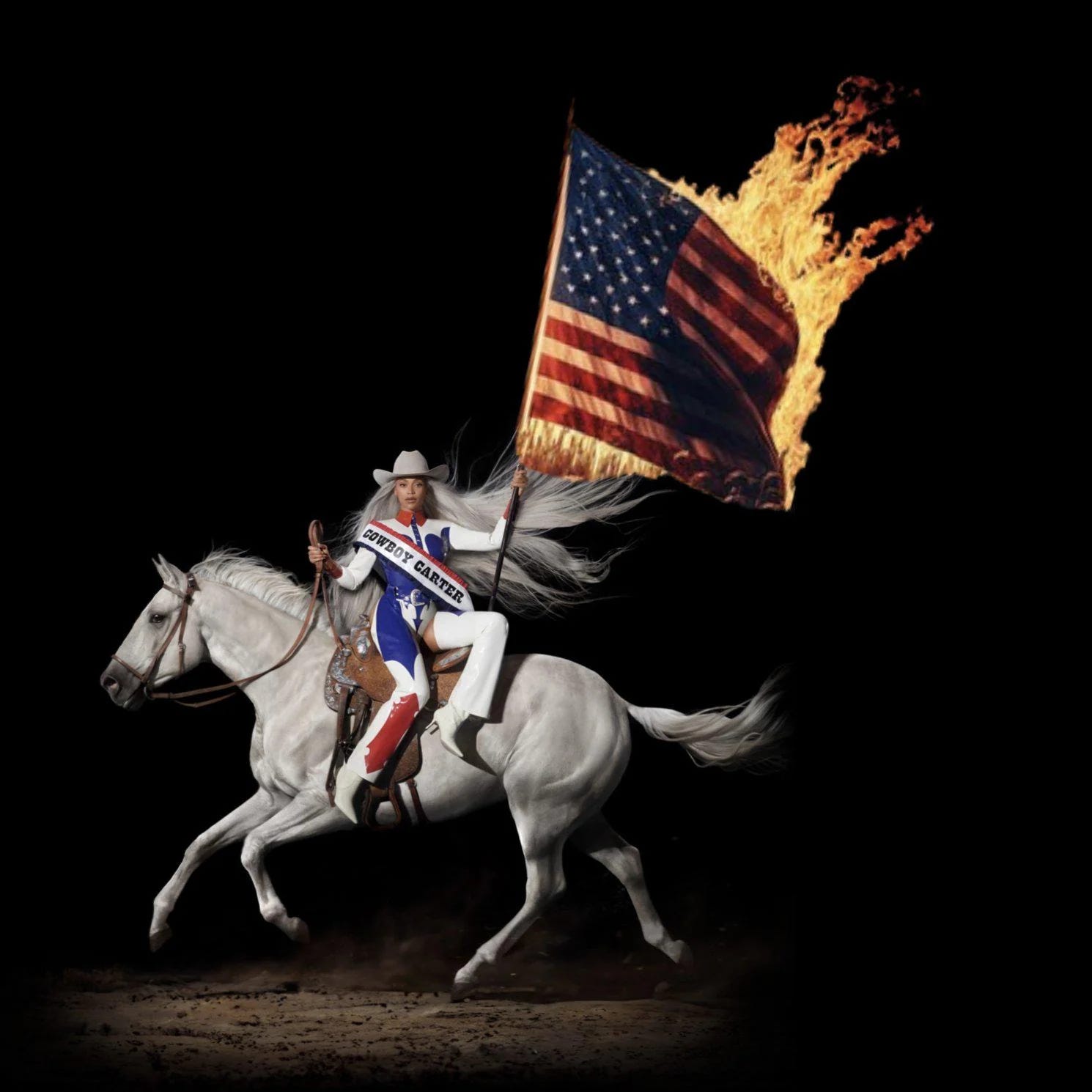
This question came about from the reactions and subsequent discourse surrounding Beyoncé and Kendrick Lamar’s performance, satire, and critique of the United States on the grand stage. Cowboy Carter, Beyonce’s eighth studio album, is an homage and reclamation of Black country music and Southern culture. Kendrick Lamar’s Super Bowl LIX Halftime Show highlighted a nation divided and quick to stifle Black artistic expression and protest. Both coming off the heels of Trump’s re-inaguration and the nation’s evident boiling point, is not a surprise, as music tends to follow the cultural trends and themes of the era in which it is created. Then again, I have to wonder, is the music actually doing anything, or are the catchy beats enough just to turn that boil down to a simmer?
In this essay, when I refer to pop music, I specifically mean music that is popular rather than the specific style or genre. This allows me to include country and rap/hip-hop as forms of popular music in the United States and to idealize how each is “sold” to the masses through performative (i.e. the performance of a social or cultural role) acts of affirmation, rejection, and compromise. “Genres are a funny little concept, aren’t they?” says Linda Martell on “SPAGHETTII,”, and I’d have to agree, as putting Black musical expression into neat genre boxes is nearly impossible when we examine the history and influence of Black people on American popular music as a whole. I cannot say for sure that this essay will have a solid conclusion, but what I can say is that it will force us to weigh the importance and impact of performance on the masses and what the viewer/consumer takes from it.
Full disclosure, I am a Beyoncé fan, and I thoroughly enjoy Kendrick’s music/artistry. I’m also greedy, having seen Beyoncé three times over the past decade and probably one more time when she inevitably tours for Act III. All this to say, I was in fact present at Northwest Stadium on the Fourth of July for the advertised “DC” stop on her Cowboy Carter Tour as well as tuned into the Super Bowl to watch Kendrick’s Halftime Performance. Call me a hypocrite, but watching these performances as both a fan and a cultural critic made me wonder: How much does performance impact political reflection and action on the individual viewer, and is that impact harmful or empowering?
On July 4th, 2025, Beyoncé opened the DC show of her Cowboy Carter Tour with “American Requiem,” a song that sings to a nation at its own funeral. A dying image of its once brilliant facade. On its own, it’s a powerful statement, but within its Americana context, I couldn’t help but feel a sense of unease as that statement gets washed away as Beyoncé sings those lyrics on our nation’s birthday, decked out in fabulous sparkly red, white, and blue designer. Some said she was reclaiming the flag; others said she was advancing American propaganda. It made me wonder if I was necessarily proud to consider myself not just Black, but specifically Black American and to be included within this narrative of reclamation. Like James Brown, “I’m Black, and I’m proud.” I’m Southern, and I’m proud. I’m an American, and I’m… ashamed? Therefore, is reclamation more so a tool of distraction? Maybe? Does reclamation invite us to learn more for ourselves? Absolutely.
Consequently, it’s vital we remind ourselves how important it is, even as fans, to carefully examine who Beyoncé is and isn’t. I view Beyoncé as an ancestral venerator and conduit of Black musical tradition. Not a savior, definitely not a Black Panther soldier, but instead a storyteller, an entertainer. As a 21st-century pop culture griot, she is the harbinger of a new era of Black media consciousness. Like the great YouTube Video essayist F.D. Signifier said, “America’s biggest export historically is not democracy, but art made by black people.”
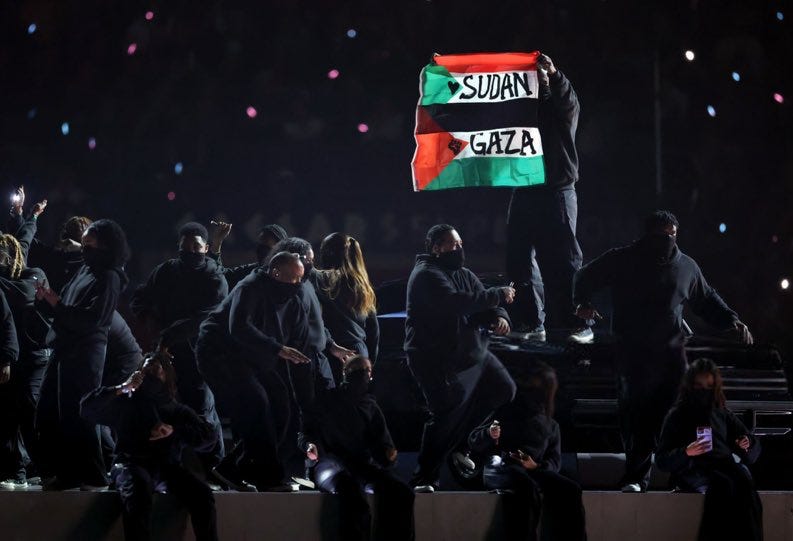
Of course, she’s not alone in this endeavor. Take Kendrick Lamar’s “Not Like Us” for example. As one of 2024’s biggest rap songs, “Not Like Us” took the feud between Kendrick and Drake and launched it into the cultural stratosphere. We saw this while watching the Super Bowl as Kendrick and the crowd screamed: “tryna strike a chord and it’s probably A minor!” Kendrick’s performance took an interpersonal feud between rappers and used it as a jumping point to turn the camera towards the nation, demanding it look and bear witness (e.g., Trump was in attendance) to the people’s frustration and rage. Yet, all of this on one of the biggest nights for commercial advertising.
Thus, the conscious viewer then must ponder, who is the “us” Kendrick is speaking to, and why exactly is he telling me this? Why am I being shown a caricature of Uncle (Tom) Sam while the NFL has backed this entire performance? Which form of protest is permissible and which is punished? The viewer’s emotions can feel hypocritical as they hear Kendrick shout, “turn this TV off,” while said viewer is watching his performance—sponsored by Apple Music and Roc Nation on NBC. It seems to complicate Gil Scott Heron’s utterance that “the revolution will not be televised,” therefore foregoing the older rally cry for a new one where folks can be united in the performance of Blackness juxtaposed with complicated images of Americana on huge multimedia platforms.
Naturally, Black people owe no allegiance to a country that forced them to build it as slaves, nor were some of these enslaved people seeking to reclaim an image of their forced persecution. We have been owed that debt for centuries, and yet we never did get our 40 acres and a mule. Instead, one might argue that we’ve been given the bread and circuses to quell our need to rise up. So, how do these songs and performances make us feel a bit better about our continued subjugation? The beauty of performance and performance theory as a whole lies in its ability to convey messages through unique forms of cultural staging that can then be repeated by others (i.e., performativity). Blackness is then structured as a spectacle upon these stages for non-Black folks to empathize or pathologize and Black folks to emulate and self-fashion, or create their own sense of self. As a result, spectacle and entertainment can be used as a form of protest, and even as a resistance strategy; how effective it will be is up to each individual viewer to carefully understand where they stand and how they interpret that message towards direct action, whether through acts of affirming, rejecting, or compromising the nation-state.
Ultimately, will I be front row at the Beyoncé Act III tour? Yes, I am a woman of many contradictions and moral flaws. I love the South. I love Black people. I love our southern drawl and how loud we can get when in the comfort of each other’s company. I love the music we create and how it is often used as a conduit for our emotions and stories to be heard. I love being Black and from the South, but I do not love this country. I want this country, the institution to fall, and the people to prosper.
Like Nina Simone, I too wonder, “How can you be an artist and not reflect the times?” Whether it’s Beyoncé, Kendrick, or any other Black artist, the rest of this decade will be defined by this grappling between nationhood, citizenship, resistance, and survival. The ultimate goal hasn’t changed, of course. Burn down the Amerikkkan Plantation, but make sure to play some good music before you do.